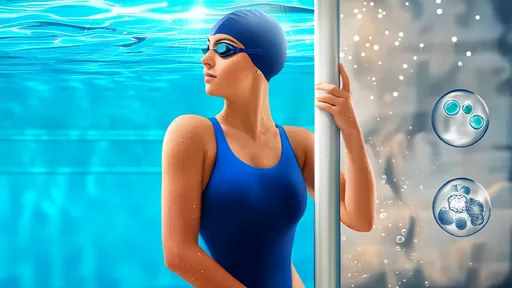
The image of gliding effortlessly through crystal blue water has cemented swimming's reputation as the ultimate low-impact exercise. Gyms market aquatic workouts as "joint-friendly," rehabilitation specialists prescribe pool therapy for injured athletes, and retirees flock to morning lap sessions believing they've found the fountain of youth. But beneath the surface of this "zero-injury" myth lies a murkier reality—one where chlorine wars against our microbiome, repetitive strokes strain shoulders to their anatomical limits, and submerged ears become battlegrounds for opportunistic infections.
The Chlorine Paradox
Municipal pools couldn't function without chlorine's bacteria-slaying properties, yet this chemical guardian exacts a toll. Studies from the University of Porto reveal competitive swimmers exhibit lung irritation markers comparable to mild asthma—a condition dubbed "lifeguard lung." The culprit isn't chlorine itself, but chloramines formed when the disinfectant binds to sweat, urine, and skin cells. These volatile compounds hover at water level, where swimmers inhale them with every turn to breathe.
Dermatologists note another frontline in this chemical warfare: the skin barrier. Regular swimmers often develop "swimmer's xerosis"—a Sahara-dry skin condition where chlorine strips protective lipids. Paradoxically, the very water that buoyantly supports joints leaves epidermis cells parched and cracking. Some Olympic teams now employ "pre-soaking" protocols, having athletes shower before entering the pool to reduce chlorine absorption by waterlogged skin.
Shoulders: The Achilles' Heel of Aquatic Athletes
Watch any elite freestyler and you'll witness human shoulders operating at the edge of evolutionary design. The arm's 360-degree rotation—a marvel that enabled our ancestors to throw spears—becomes its downfall when subjected to thousands of repetitive overhead motions. Yale biomechanists found that during a single mile of freestyle, each shoulder rotates approximately 1,200 times, compressing vulnerable tendons between the humerus and acromion.
This mechanical stress manifests brutally in masters swimmers. A Johns Hopkins study tracking athletes aged 40-65 revealed 47% had rotator cuff abnormalities—many asymptomatic until a minor tweak cascaded into debilitating injury. Coaches now emphasize "stroke diversity," mixing backstroke and breaststroke to redistribute muscular loads. Some physiotherapists even prescribe land-based resistance training to strengthen the very joints swimmers aim to protect by avoiding impact sports.
Ears, Nose, and Throat: The Unseen Casualties
Otolaryngologists know swimmers by their distinctive pathologies. "Surfer's ear"—bony growths in the ear canal from chronic cold water exposure—now appears in indoor pool devotees. More insidious are the biofilm communities thriving in moist ear canals post-swim, where Pseudomonas aeruginosa can transform a leisurely dip into a painful otitis externa infection. The nose fares no better; chlorine-induced rhinitis plagues up to 38% of regular swimmers according to Belgian allergy studies.
Perhaps most surprising is the dental erosion emerging as a silent epidemic. pH levels in poorly maintained pools can drop to tooth-dissolving acidity—a 2012 study in The Journal of the American Dental Association found competitive swimmers had significantly higher enamel erosion than non-swimmers. Some teams now mandate pH testing of training pools, while dentists advocate for post-swim fluoride rinses.
Mitigating the Damage
None of this negates swimming's cardiovascular benefits or its unparalleled value for mobility-limited individuals. The wisdom lies in swimming smarter—shorter sessions in well-ventilated pools, alternating strokes to prevent overuse injuries, and using protective measures like earplugs and pre-swim moisturizers. As with any exercise, the dose makes the poison. The water that gives us weightless freedom demands respect for its hidden battles.
Ultimately, the "zero-impact" label does swimmers a disservice by implying zero risk. Acknowledging these vulnerabilities allows athletes to harness swimming's gifts while defending against its quiet assaults. After all, even fish must constantly adapt to the water's demands—and they evolved there.

By /Jun 19, 2025

By /Jun 19, 2025
By /Jun 19, 2025

By /Jun 19, 2025

By /Jun 19, 2025

By /Jun 19, 2025

By /Jun 19, 2025

By /Jun 19, 2025

By /Jun 19, 2025

By /Jun 19, 2025

By /Jun 19, 2025

By /Jun 19, 2025
By /Jun 19, 2025

By /Jun 19, 2025
By /Jun 19, 2025
By /Jun 19, 2025

By /Jun 19, 2025

By /Jun 19, 2025
